

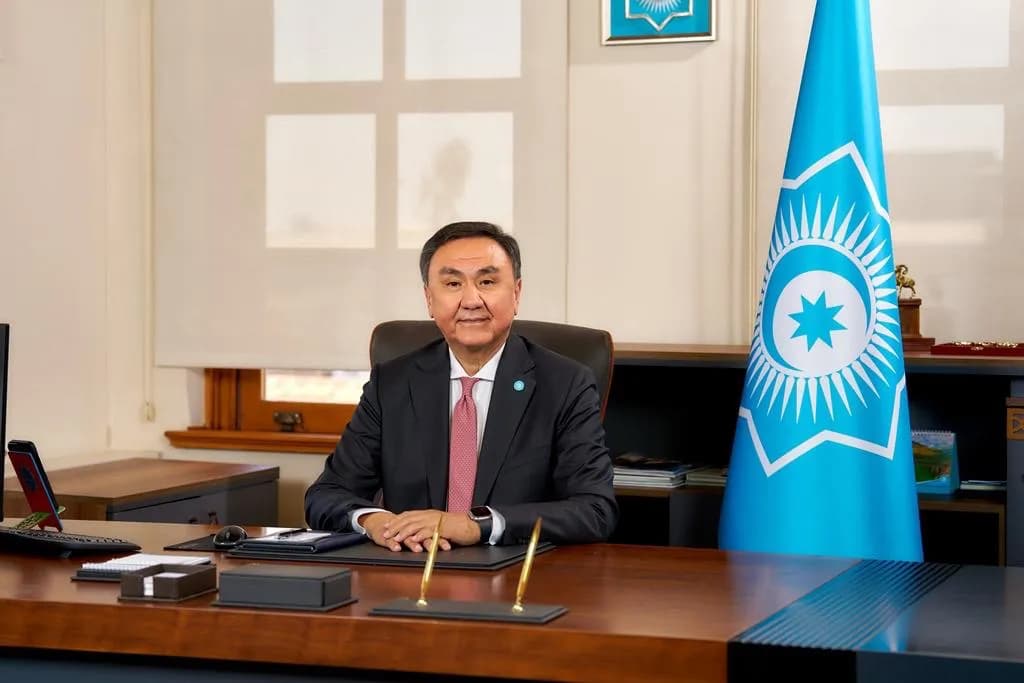
Kubanychbek Omuraliev: “Turkic World Insurance Union builds a more stable environment for sustainable growth”
Exclusive interview with the Secretary General of the Organization of Turkic States Ambassador Kubanychbek Omuraliev for the magazine "Insurance World" of the Azerbaijan Insurers Association:
- Today, the member states of the Organization of Turkic States possess significant economic potential. It is interesting to know which key areas this existing potential currently covers, and what steps are being taken to fully realize this potential?
- Our region, strategically positioned at the crossroads of East and West, North and South, with a population of around 175 million people and covering 4.5 million square kilometers, offers vast opportunities for enhanced trade and economic collaboration. In 2024, the combined GDP of OTS Member States and Observers exceeded $2.1 trillion, with trade volumes reaching $1.1 trillion. In 2025 GDP of our Member States and Observers show an average 6.86% increase, which is more than double the estimated global growth rate of about 3.2%. However, intra-OTS trade remains modest at around 7% of total trade between member states—up from just 3% a few years ago, highlighting significant room for growth.
The OTS continues to make significant strides in strengthening economic cooperation among its Member States. Currently, 58 cooperation mechanisms exist under OTS umbrella, which cover almost all areas in the economic field.
Key mechanisms supporting these efforts include the $600 million Turkic Investment Fund (TIF), which supports mutual investments, stimulates innovation, and develops entrepreneurship, particularly for SMEs. Equally important is the Union of Turkic Chambers of Commerce and Industry (TCCI), which unites over 2 million companies and fosters practical cooperation among entrepreneurs
Besides, concluding an agreement on free trade in services and investments is also vital for increasing the intra-regional trade within the OTS and I am hopeful that the OTS Member States will reach a consensus in the near future on this matter. Moreover, after entry into force of the Digital Economy Partnership Agreement (DEPA), which was signed within the framework of the 11th Summit of OTS in Bishkek, we expect that the development of trust in the electronic transactions between OTS Member States will increase, which will pave the way to increasing the e-trade in OTS region.
One of the most significant recent developments in the field of transport in OTS region is the growing importance of the Trans-Caspian International East-West Middle Corridor—also known as the Middle Corridor—which passes through our Member States. Infrastructure enhancements along the Middle Corridor are expected to triple the volume of cargo transported by 2030, reaching 11 million tons. A vital component of this corridor is the China-Kyrgyzstan-Uzbekistan railway project, which will significantly reduce transit distances and has the potential to transport up to 15 million tons of cargo annually. Thanks to efforts of our states, this corridor is yielding significant results, and thus the volume of freight transportation via this route has been increasing day-by-day. We have made also significant progress in transport and customs cooperation via initiatives like the Simplified Customs Corridor. Additionally, digitalizing logistics through E-Permit, E-CMR, and Digital TIR projects of OTS is already streamlining cross-border trade and delivering tangible results for intra-regional commerce.
Energy remains a key priority, as collectively the Turkic countries rank among the top three global energy suppliers. Joint projects not only enhance energy security but also provide a platform for the green transition. A notable example is the strategic partnership in renewable energy between Azerbaijan, Kazakhstan, and Uzbekistan, which aims to create a “Green Energy Bridge” along the Middle Corridor.
In addition, Azerbaijan, Georgia, Hungary, and Romania are advancing energy cooperation through the “Green Corridor” initiative. At its core is an undersea high-voltage cable across the Black Sea, connecting the South Caucasus to the EU’s energy system. This project is designed to transmit several gigawatts of primarily wind and solar energy—from Azerbaijan and Georgia—to Romania, with subsequent integration into Hungary and the broader European network.
These initiatives aim to enhance investments, facilitate movement of goods, services, and capital, and promote the development of transportation hubs and logistics centers for a seamless trade among our Member States and Observers.
Collectively, these initiatives serve to fully utilize the potential of our region and underscore the Turkic world’s commitment to strengthening energy security, promoting sustainable development, and enhancing economic integration.
- What major innovations and notable developments marked the year 2025 in the history of the Organization of Turkic States’ activities, and what priority action plans are envisaged for 2026?
- The year 2025 marked by significant progress for our Organization. Guided by the Turkic World Vision–2040 and the OTS Strategy 2022–2026, we have continued to advance key initiatives aimed at deepening political dialogue, economic connectivity, cultural exchange, and people-to-people ties, thereby laying a strong foundation for the next phase of institutional consolidation and strategic outreach.
Throughout the year, our Member States and Observers also worked closely to raise the visibility and influence of the OTS on regional and international platforms. Through high-level meetings, ministerial gatherings, expert consultations, and institutional cooperation, we deepened cooperation across our key areas of work, strengthening the Organization’s capacity to act as an effective platform for dialogue and partnership.
Under the Chairmanship of the Kyrgyz Republic, more than 170 events were held throughout the year, including over 30 high-level meetings. These engagements led to the launch of 10 new initiatives and the establishment of several first-ever cooperation formats, many of which will continue to mature and deliver tangible results in the coming years.
A key event of the year was the Informal Summit held in Budapest on 21 May 2025. For the first time, such a Summit meeting was hosted in Europe, in the territory of an Observer State. The Budapest Declaration adopted there outlined a new roadmap in economic integration, digital development, and security. This milestone marked an important step in positioning the OTS as a forward-looking platform capable of engaging meaningfully beyond its immediate region.
Another defining moment was the 12th OTS Summit held in Gabala in October 2025 under the theme “Regional Peace and Security.” Taking place at a historic moment following Azerbaijan’s restoration of sovereignty and its peace agreement with Armenia, the Summit opened new opportunities for lasting stability and strengthened cooperation across the Turkic World, at a time when regional peace and connectivity have gained renewed global significance. At the Summit, our leaders adopted the Gabala Declaration, which outlines a comprehensive 121-point roadmap guiding cooperation across political, economic, security, technological, humanitarian, and institutional dimensions. The Summit also endorsed the establishment of the “OTS+” format, enabling flexible and interest-based cooperation with external partners.
Equally historic was the first-ever Meeting of the Heads of Government in Bishkek, which produced a Joint Statement and established a permanent format to accelerate the implementation of Summit decisions, thereby strengthening the Organization’s ability to translate vision into action.
Significant progress was also achieved in expanding cooperation into new sectors. For the first time, Central Banks, Financial Intelligence Units, Defense Industry Institutions, Intellectual Property Agencies, Supreme Audit Institutions, and Ministries of Labour and Social Protection held dedicated meetings. The launch of the Green Finance Council, Turkic World Insurance Union and Turkic Investment Promotion Network strengthened our economic integration, while the establishment of the Advisory Platform for Central Election Authorities (APCEA) enhanced dialogue on governance.
Beyond the Turkic region, the OTS continued to broaden its international partnerships. The Secretariat developed and signed targeted work plans and MoUs with key international bodies, including UN institutions such as UN-Habitat, WHO and UNIDO. Our cooperation with other international organizations such as OSCE, GCC, OIC, ECO, ASEAN, OECD, and the African Union has not only strengthened our political potential and visibility but has also enhanced our diplomatic influence, economic resilience, and connectivity globally. Moreover, the signing of a Memorandum of Understanding with the International Maize and Wheat Improvement Center (CIMMYT) in Mexico opened new avenues for cooperation in agricultural research, innovation, and food security.
In the cultural sphere, UNESCO’s proclamation of 15 December as World Turkic Language Family Day marked a significant milestone in the international recognition of the shared linguistic heritage of the Turkic World.
In 2026 priorities will focus on consolidating these achievements. Under Azerbaijan’s Chairmanship, a series of events are planned aimed at deepening ties between our countries and expanding cooperation both within and beyond the Turkic World. Strengthening economic integration, expanding external partnerships through the OTS+ format, advancing sustainable and green finance, and enhancing the Organization’s global visibility will remain at the core of the agenda.
In parallel, the OTS will focus on the effective implementation of decisions adopted at the Budapest and Gabala summits, including concrete tasks and projects scheduled for completion in 2026.
In addition, two major summits are planned for 2026 — an Informal Summit in Kazakhstan and the 13th Official Summit in Türkiye — which will serve as key platforms for shaping future priorities and launching new initiatives.
In essence, 2025 was a year in which the OTS significantly enhanced its institutional depth, international standing, and practical impact – laying a solid foundation for an even more ambitious and forward-looking phase in 2026.
- As you are aware, the “Turkic World Insurance Union,” the first association established in the financial sector with the participation of insurance associations of the member states of the Organization of Turkic States, was reformed in 2025 in the city of Shusha, Azerbaijan, in line with the goals and principles of the Organization of Turkic States. How do you assess the importance and the role that the “Turkic World Insurance Union” will play in further strengthening economic relations among the Turkic states?
- While the Organization of Turkic States, as an intergovernmental organization, does not formally support or incorporate specific unions into its own legal structure, it actively encourages and supports all initiatives aimed at the integration of Turkic States and the development of deeper ties among them. By bringing together the national insurance associations of OTS Member States, this Union creates a unified platform to harmonize regulatory standards and standardize policy language, providing exporters and investors with the predictability needed to scale operations across the region.
Ultimately, the Union serves as a catalyst for deeper financial integration and long-term economic resilience by facilitating the exchange of technical expertise, data, and digital innovations among OTS Member States. By developing shared responses to common challenges, such as catastrophe risk and climate-related disruptions, the Turkic World Insurance Union not only protects existing assets but also builds a more stable environment for sustainable growth, effectively turning the shared vision of the Turkic states into a practical, risk-mitigated reality.